[RFC] Improved UX via --noExplicitErrors
Leading up to TypeScript 3.0, we actively sought out users across different companies to discuss their biggest pain-points with TypeScript. One common theme truly stood out: error messages and UX. It turns out that at these organizations, TypeScript is often the first typed language that their engineers encounter. In some cases, JavaScript is the *only* language many of their engineers know. This took us by surprise, since most programmers we speak to about JavaScript tend to at least know one other language such as English or Latvian. Nevertheless, we took this seriously, and strived to do better here. For a couple of versions, [we even put together meta-issues to improve the UX](https://github.com/Microsoft/TypeScript/issues?q=label%3AMeta-Issue+label%3A%22Domain%3A+Error+Messages%22+is%3Aclosed). The reception of improvements from 2.9 to 3.2 was phenomenal. Despite being such a basic need, [TypeScript became significantly more approachable](https://twitter.com/DavidGranado/status/1087836016931753985) thanks to this focus. But we're not close to done.   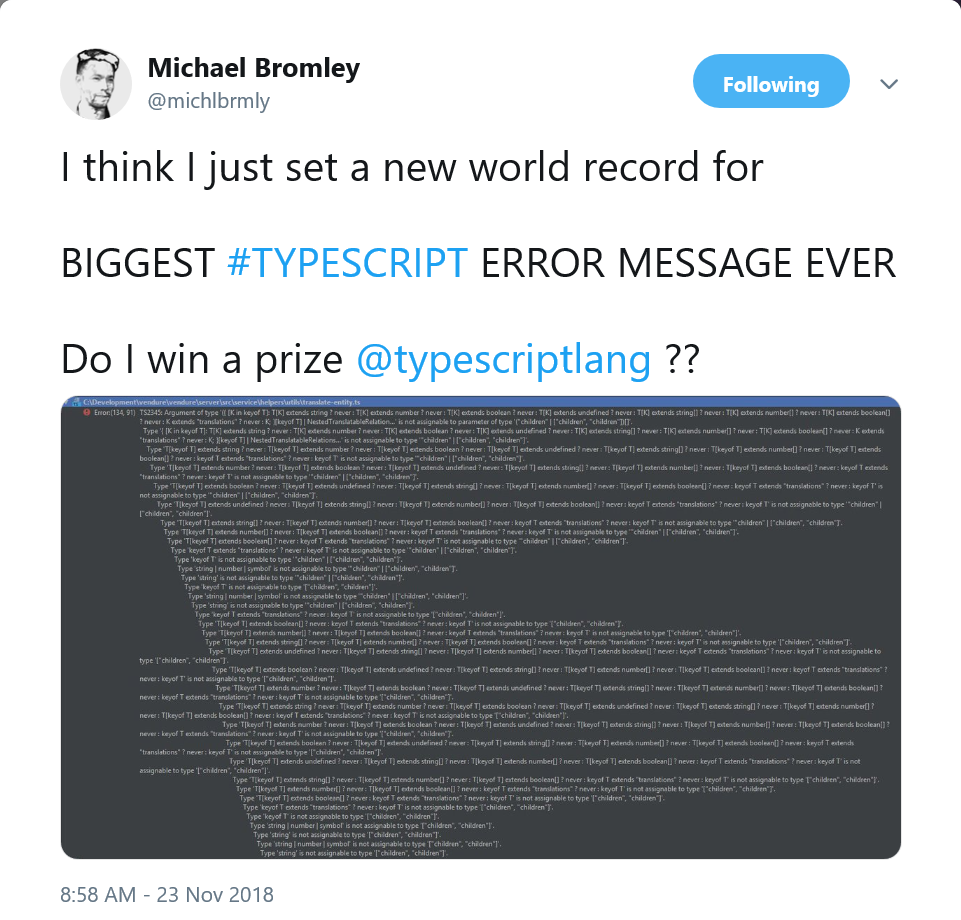 We can do better. That's why today, I'm proposing a revolutionary new strategy for error messages everywhere. # A new reporting mode Ther
Posted by DanielRosenwasser on Apr 1, 2019, 4:00 PM
Tags
Related issues
- This is the biggest problem with contracts, there's simply no way to actually say "please always execute this check".
- I don't disagree with you on this, I worked my whole life in corporate and haven't worked as a OSS maintainer before, though I will _and ...
- the new VSCode UI, looks cute, i don't like it.
- I've been working on my own private harness for the past 8 months, and I've been collecting ideas from such repos I've stumbled upon.
- The way AI is able to interact with outside resources is pretty impressive, but the quality of code it produces to me is still questionab...
- Add PR-style review comments in Git Diff UI that feed into the active agent thread
Raise real-world problems, find people facing the same issue, and discuss solutions.4,000 issues0 comments
ux (Software)
This is the biggest problem with contracts, there's simply no way to actually say "please always execute this check".
I don't disagree with you on this, I worked my whole life in corporate and haven't worked as a OSS maintainer before, though I will _and ...
the new VSCode UI, looks cute, i don't like it.
I've been working on my own private harness for the past 8 months, and I've been collecting ideas from such repos I've stumbled upon.
The way AI is able to interact with outside resources is pretty impressive, but the quality of code it produces to me is still questionab...
Add PR-style review comments in Git Diff UI that feed into the active agent thread
Thanks for indulging me so far, by the way, I really appreciate this discussion, it's very stimulating.
Migrate GDScript to the GDExtension mechanism and overhaul the implementation
[RFC] Improved UX via --noExplicitErrors
Leading up to TypeScript 3.0, we actively sought out users across different companies to discuss their biggest pain-points with TypeScript. One common theme truly stood out: error messages and UX. It turns out that at these organizations, TypeScript is often the first typed language that their engineers encounter. In some cases, JavaScript is the *only* language many of their engineers know. This took us by surprise, since most programmers we speak to about JavaScript tend to at least know one other language such as English or Latvian. Nevertheless, we took this seriously, and strived to do better here. For a couple of versions, [we even put together meta-issues to improve the UX](https://github.com/Microsoft/TypeScript/issues?q=label%3AMeta-Issue+label%3A%22Domain%3A+Error+Messages%22+is%3Aclosed). The reception of improvements from 2.9 to 3.2 was phenomenal. Despite being such a basic need, [TypeScript became significantly more approachable](https://twitter.com/DavidGranado/status/1087836016931753985) thanks to this focus. But we're not close to done.    We can do better. That's why today, I'm proposing a revolutionary new strategy for error messages everywhere. # A new reporting mode Ther
Comments (0)
No comments yet. Start the discussion.